Many people who dream of living a spectacle-free life delay their decision because of one persistent, nagging question: "What if my eyes move or I accidentally blink during the laser procedure?" This is a completely natural fear. It is easy to feel that we must remain absolutely motionless on the treatment bed, and the thought that an involuntary blink or eye tremor could compromise our vision correction results creates understandable anxiety.
The reality, however, is far more reassuring: the human brain and eye are never completely still. Even when you consciously try to focus your gaze on a single point, your eye involuntarily drifts about 90 micrometers every single millisecond. This means that constant microscopic eye movement is not an unexpected obstacle or a surgical risk—it is a fundamental biological fact around which modern laser technology is specifically built.
How Modern Laser Technology Adapts to Natural Eye Movement
The Flow3 procedure performed at KSA Vision Clinic (KSA Silmakeskus) does not expect you to remain perfectly motionless; instead, it dynamically adapts to your eye's natural movements in real time.
A Laser That Sees a Fraction of a Second Into the Future
Older laser systems operated on a reactive basis: they detected eye movement and then tried to catch up. Modern laser technology, however, works differently: it is predictive.
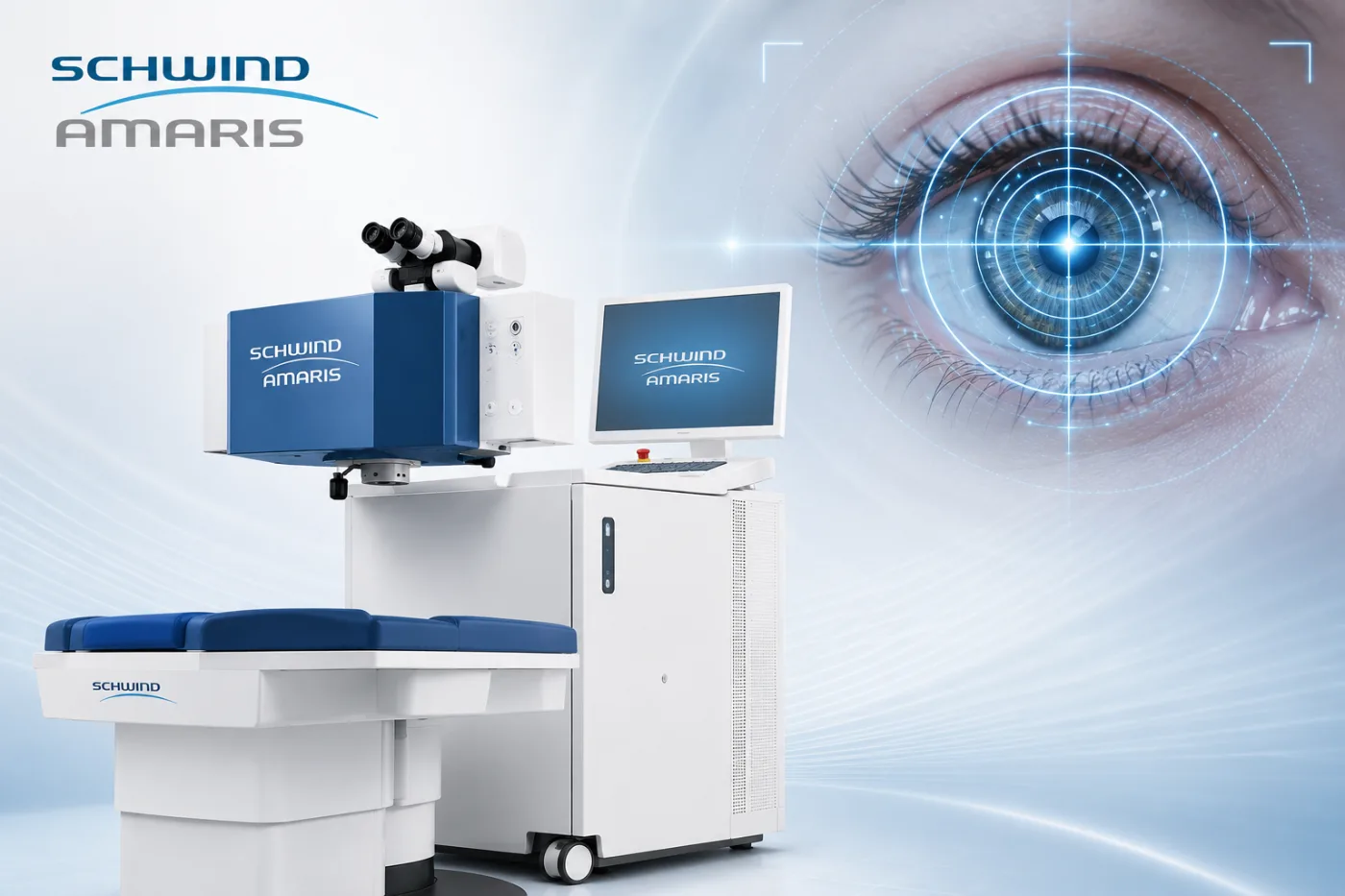
The SCHWIND AMARIS 1050RS laser used in the Flow3 procedure is equipped with an eye-tracking system that performs 1,050 measurements per second. Rather than simply reacting to movements that have already occurred, the system continuously analyzes your eye's unique movement patterns.
In the brief fraction of a millisecond between the tracker's measurement and the firing of the next laser pulse, the system calculates the eye's precise trajectory and predicts exactly where your eye will be at the very moment the next laser pulse arrives. This is known as Latency-Free Tracking. Thanks to this predictive math, the laser dynamically realigns its mirrors before the pulse is fired, ensuring microscopic accuracy.
Safety in Seven Dimensions: How the System Works
To understand how thoroughly the system protects your eyes, it helps to look at how the device divides its tracking across different dimensions of space and time. While standard tracking systems only detect basic horizontal and vertical shifts, the AMARIS 1050RS compensates for eye movements in seven distinct dimensions:
1st & 2nd Dimensions (Lateral Shifts). The system compensates for basic horizontal and vertical shifts as the eye slides side-to-side or up-and-down.
3rd & 4th Dimensions (Rolling Movements). The eyeball can tilt or roll within its socket. The system detects these rolling rotations to prevent misalignments between the center of the pupil and the intended laser target.
5th Dimension (Cyclotorsion). Cyclotorsion refers to the rotational spinning of the eye around its visual axis. This happens naturally when you lie down flat from an upright sitting position, as well as in tiny dynamic twists during the procedure. The system tracks and neutralizes both static and dynamic rotation in real time.
6th Dimension (Z-Tracking). This dimension measures and corrects for up-and-down movements along the vertical Z-axis. If your head or eye moves slightly due to breathing or swallowing, the system instantly adjusts the laser's focus to keep it perfectly aligned on the corneal surface.
7th Dimension (Time). This is the predictive, latency-free tracking mentioned above, which calculates the eye's future position and completely eliminates system response delay.
In addition to these seven dimensions, the system features Pupil Centroid Shift (PCS) Compensation. Because your pupil naturally changes size under different light levels and its center shifts slightly, the tracker uses the limbus (the stable boundary where the clear cornea meets the white of the eye) as an unchanging reference point. This ensures the laser remains perfectly centered regardless of pupillary changes.
The Numbers Speak for Themselves: Reducing the Need for Retreatments Four-Fold
This comprehensive tracking technology is not just an impressive list of specifications—it has a direct, measurable impact on patient safety and visual outcomes. Clinical studies show that utilizing an active, multi-dimensional eye-tracking system significantly reduces the need for touch-up procedures.
Without active eye tracking, the average surgical retreatment rate stands at 8.2%. With the integration of advanced active tracking, this rate drops to just 2.2%. This proves that automated tracking makes the procedure multiple times more stable and the outcomes highly predictable, giving patients peace of mind. Your eye's tiny, involuntary movements will not affect your results because the technology is always one step ahead.
A Spa-Like Journey: Painless, Touchless Flow3
For many, the word "surgery" conjures up images of cold metal instruments, sharp blades, and a clinical, intimidating environment. The Flow3 procedure at KSA Vision Clinic completely redefines this experience, offering a journey that feels much closer to a relaxing spa visit than a medical procedure.
Flow3 is a completely touchless and cut-free procedure. Unlike older correction methods, no cuts or incisions are made, and no mechanical tools are used to create a corneal flap. The laser works entirely on the surface of the cornea in a painless, contact-free manner.
Even better, the entire experience is swift:
- The laser itself runs for only 10 to 30 seconds per eye—shorter for mild refractive errors, and slightly longer for larger ones.
- The total time spent in the treatment room is only about 15 minutes. This includes all preparations, numbing eye drops, the quick laser correction, and the placement of a protective contact lens afterward.
Throughout these 15 minutes, the atmosphere is warm, gentle, and supportive. The procedure is entirely painless, and the doctor and patient chat comfortably throughout. Soft, carefully selected ambient music plays in the background, helping any remaining anxiety drift away.
From your very first suitability assessment to your personalized recovery plan and 24/7 post-operative clinical support, you are fully cared for.
KSA Vision Clinic is the only eye clinic in Estonia equipped with the SCHWIND AMARIS 1050RS laser for vision correction. By choosing the Flow3 procedure, you are placing your vision in the hands of technology that tracks and adapts to every microscopic movement of your eye in real time.
If you are ready to find out if Flow3 is the right match for your eyes, take the first simple step and book a comprehensive Flow3 diagnostic eye examination at KSA Vision Clinic.