The thought of eye surgery often conjures up clinical images of sharp surgical blades, high pressure applied to the eye, and an intimidating medical environment. However, modern vision correction at KSA Vision Clinic is light-years away from this stereotype.
Our Flow3 procedure is designed to feel like a relaxing spa visit: you spend about 15 minutes in a cozy, welcoming treatment room filled with soft ambient music, chatting comfortably with your surgeon. In this peaceful and entirely painless setting, the actual laser treatment runs for just 10 to 30 seconds per eye.
But beyond physical and mental comfort, the Flow3 procedure offers a far more important advantage: it is biologically protective. In this article, we explain in simple terms why a completely touchless, cut-free procedure supports the long-term health and strength of your eyes.
Understanding Your Cornea: The Eye's Natural Shield
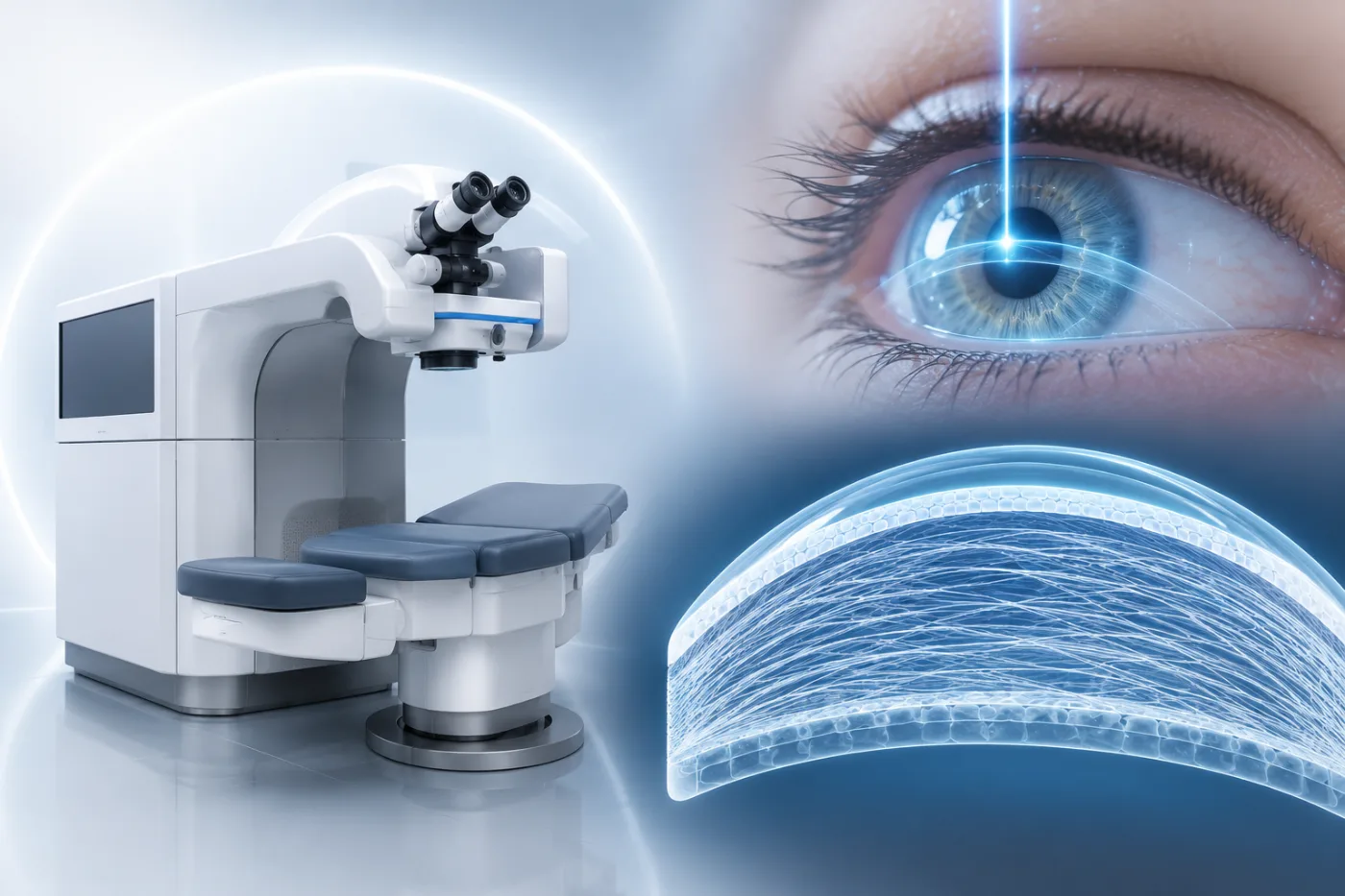
To understand why avoiding surgical cuts is so important, we must look briefly at the anatomy of the eye. The front of the eye is protected by a thin, transparent layer of tissue called the cornea. The cornea is not just a "window" that lets light in; it is the eye's primary biomechanical support and protective shield.
The most critical fact about the cornea is that its strength is not distributed evenly. The strongest and most resilient fibers are located in its very uppermost layers (the anterior stroma). These superficial layers are responsible for maintaining the eye's shape and withstanding natural intraocular pressure.
The Flap Dilemma: What Happens When You Cut the Cornea?
Traditional laser procedures (such as LASIK or FemtoLASIK) rely on making a mechanical cut. During these procedures, the surgeon uses a blade or a specialized laser to make a circular incision in the cornea, creating a flap that is about 100 micrometers thick. This flap is lifted, the laser reshapes the deeper layers, and the flap is folded back down.
While this method is widely performed, it introduces certain biomechanical and biological compromises:
Biomechanical Weakening: The incision permanently cuts through the cornea's strongest upper fibers. The repositioned flap never biomechanically fuses back with the rest of the cornea—it remains there essentially like a natural band-aid. Consequently, the eye's overall structural strength is noticeably reduced.
Severed Nerve Fibers: The cut severs the sensitive corneal nerves responsible for regulating tear production. This is the primary reason why many patients experience long-term dry eye symptoms after traditional LASIK.
Flap-Related Risks: Because the flap never fully heals or bonds back to its original strength, there remains a lifelong, microscopic risk that a strong impact or trauma (such as during sports or an accident) could dislodge or displace the flap.
The Flow3 Solution: 100% Touchless and Cut-Free Technology
The Flow3 procedure performed at KSA Vision Clinic (utilizing the TransPRK method combined with SmartPulse technology) takes a completely different approach. It is 100% contact-free and cut-free.
This means:
No Incisions, Blades, or Flaps: The laser operates directly on the surface of the cornea, gently removing the epithelium and reshaping the corneal surface in a single, continuous step without any mechanical tools ever touching the eye.
Maximum Biomechanical Strength: Because the strong upper layers of the cornea are never cut or compromised, the eye's natural structural integrity and stability remain almost entirely intact.
Faster Nerve Recovery: Nerve disruption is kept to an absolute minimum, allowing the corneal nerves to regenerate much faster and significantly reducing the risk of postoperative dry eyes.
SmartPulse and 3D Fullerene: Creating a Smooth Surface
In traditional LASIK, the repositioned flap helps mechanically smooth out the underlying stromal bed as it heals. Because surface treatments like Flow3 do not use a flap, the laser must create an exceptionally smooth surface from the very beginning to ensure rapid healing and excellent visual quality.
This is achieved through SmartPulse technology, which is built into our SCHWIND AMARIS 1050RS laser. SmartPulse uses a unique 3D Fullerene model based on organic molecular geometry to map the natural curvature of the eye.
The system calculates the cornea's exact curve in real time and optimizes the laser pulse distribution to create an incredibly smooth, step-free surface. Thanks to SmartPulse, surface healing is significantly faster and more comfortable than with older surface methods, allowing patients to achieve excellent visual clarity in the very first days following the procedure.
A Strong Choice for Active Lifestyles
Because Flow3 does not create a corneal flap, there's no repositioned flap left to displace — a real advantage for anyone living an active life.
It is the preferred choice for:
- Athletes and Contact Sports: Boxers, martial artists, basketball players, and soccer players can train without worrying about physical contact or impact to their eyes.
- Special Services Personnel: Soldiers, police officers, and firefighters can perform their high-stress duties with complete confidence.
- Active Explorers: Traveling, diving, skiing, and hiking are entirely worry-free because your eyes remain just as strong and secure as they were before the treatment.
Trust Your Eyes to Nature and Advanced Technology
The Flow3 procedure combines the wisdom of natural anatomy with the peak of modern technology. Rather than fighting your eye's natural structure with surgical cuts, we work in harmony with it—preserving your eyes' strength, stability, and long-term health.
The team at KSA Vision Clinic has performed over 55,000 successful procedures, and we know exactly how to guide you toward visual freedom safely and comfortably. Take the first step toward a clear, active life and book your comprehensive Flow3 diagnostic eye examination with us today!