
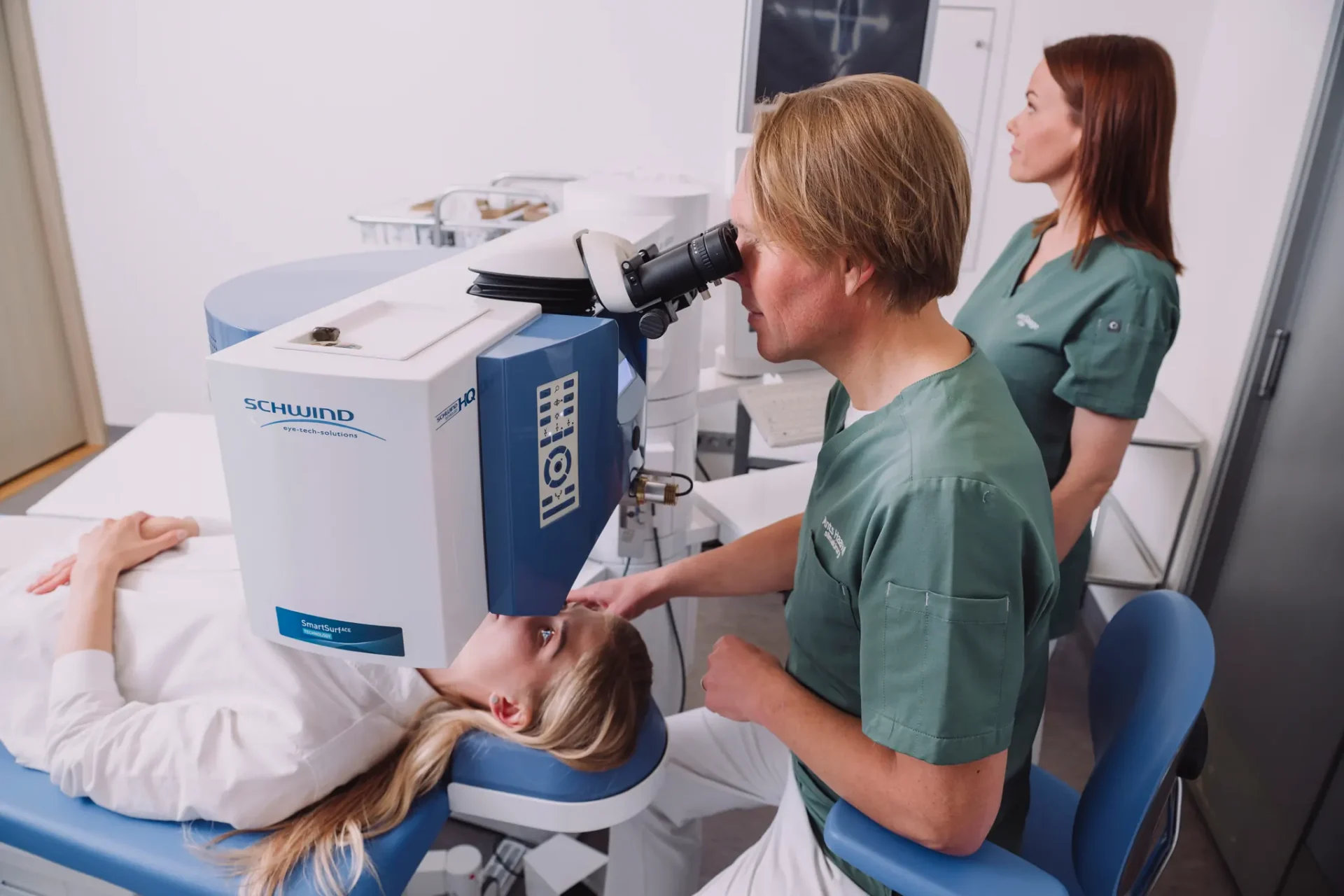
Comparison of Laser Eye Procedures
We compare the most common laser eye procedures and explain the advantages of the incision-free Flow3 method.
Flow3 vs LASIK vs SMILE – Laser vision correction comparison
The table below helps explain the key differences between the various laser vision correction methods.
- How to read the table? The comparison focuses on how each procedure affects the corneal structure, visual quality, and future treatment options.
- It is important to remember that every eye is different, and the final suitability is always determined during a pre-procedure eye examination.
| Aspect | Flow3 (flap-free and contact-free) | LASIK / FemtoLASIK | SMILE |
|---|---|---|---|
| Is a cut or flap made in the cornea? | No | Yes, a flap is created | Yes, a tunnel is created |
| Is the eye structure altered by a cut? | No | Yes | Yes |
| Is the remodelling performed without contact? | Yes | No | No |
| Does the eye structure remain permanently altered? | No | Yes | Partially |
| Is it suitable for people with an active lifestyle? | Yes | Limited | Limited |
| Suitable for correcting myopia and astigmatism | Yes | Yes | Yes |
| Does intraocular pressure (IOP) increase during the procedure? | No | Yes | Yes |
| Do future treatment options remain flexible? | Yes | Limited | Limited |
| Suitable for thinner corneas | Yes | No | No |
| Optical zone size | Larger optical zones can be planned | Standard | Standard |
Flow3 – Flap-Free and Eye-Friendly Vision Correction
Flow3 is a modern flap-free laser vision correction procedure used to correct myopia and astigmatism without creating a corneal flap or making incisions in the cornea.
The goal of the procedure is to correct vision in a way that preserves as much of the eye’s natural structure as possible and supports long-term visual stability. Individual suitability is always determined during a comprehensive pre-procedure eye examination.
- What makes the Flow3 flap-free laser procedure eye-friendly?
- No corneal flap or tunnel is created, which helps support better vision in low-light and night-time conditions.
- Larger optical zones can be planned during the procedure.
- The natural structure of the cornea is preserved as much as possible.
Why the optical zone is important
The optical zone is the central area of the cornea that is reshaped by the laser to ensure clear vision.
With Flow3, it is possible to plan larger optical zones compared to traditional flap-based methods such as LASIK and SMILE. This can help support better visual quality in different lighting conditions. The exact suitability and planning always depend on the individual characteristics of the eye.
- The size of the optical zone can affect visual quality in low-light and night-time conditions, including the occurrence of halos and glare.
- In general, a larger optical zone supports better visual quality in low-light conditions; however, the final outcome always depends on individual eye characteristics.
Our experience and a conscious approach
KSA Silmakeskus has long-standing experience in performing both flap-based and flap-free laser vision correction procedures. In the past, we were the largest provider of flap-based procedures in the Baltics and have extensive hands-on experience with the LASIK method.
Over the past 15 years, we have consciously focused on flap-free approaches. This decision is based on our clinical experience and the analysis of long-term patient outcomes.
Preserving the natural structure of the cornea as much as possible is at the core of our treatment philosophy, as it helps support stable, high-quality vision in the long term.
- Modern technology is our standard. We regularly update our laser technology, approximately every two years.
- This allows us to work with state-of-the-art, high-precision technology, plan each procedure individually, and ensure our treatments meet today’s medical standards.
- Regular technology upgrades are part of our long-term quality strategy and help support reliable, predictable treatment outcomes.
If something was unclear...
With LASIK a corneal flap is cut; with SMILE a small incision is made to remove a piece of tissue. Flow3 is a touch-free, incision-free surface method — the cornea is not cut and no flap is made; the laser works gently on the surface of the cornea.
A flap-free method removes the flap-related risk and leaves the cornea more intact. Even so, the suitability of each method depends on the parameters of the individual eye, so a thorough prior examination is always necessary.
We have long experience with both flap-based and flap-free procedures — we were previously the largest provider of flap-based procedures in the Baltics. Based on that experience we today prefer the flap-free Flow3 method, which is gentler on the cornea.
No. The choice of method depends on your vision, the thickness and shape of your cornea, and your eye health. A flap-free method suits some patients; others are better served by a different solution, or by glasses and lenses.
The Flow3 eye examination shows this — we measure thousands of parameters of your eye. Based on the results we tell you whether, and which, method best suits your eyes.
Want to get rid of myopia?
Start with a Flow3 eye examination. During the assessment, we will determine whether laser vision correction to treat myopia is suitable for your eyes.



Read the patient guide calmly before deciding
An eye examination usually brings a lot of new information about laser surgery. Dr. Ants Haavel's guide helps you understand the differences between LASIK, SMILE and Flow3, recovery, risks, and the questions to ask your doctor before deciding.
Read the introduction →The guide is free and written in language a patient can understand.