
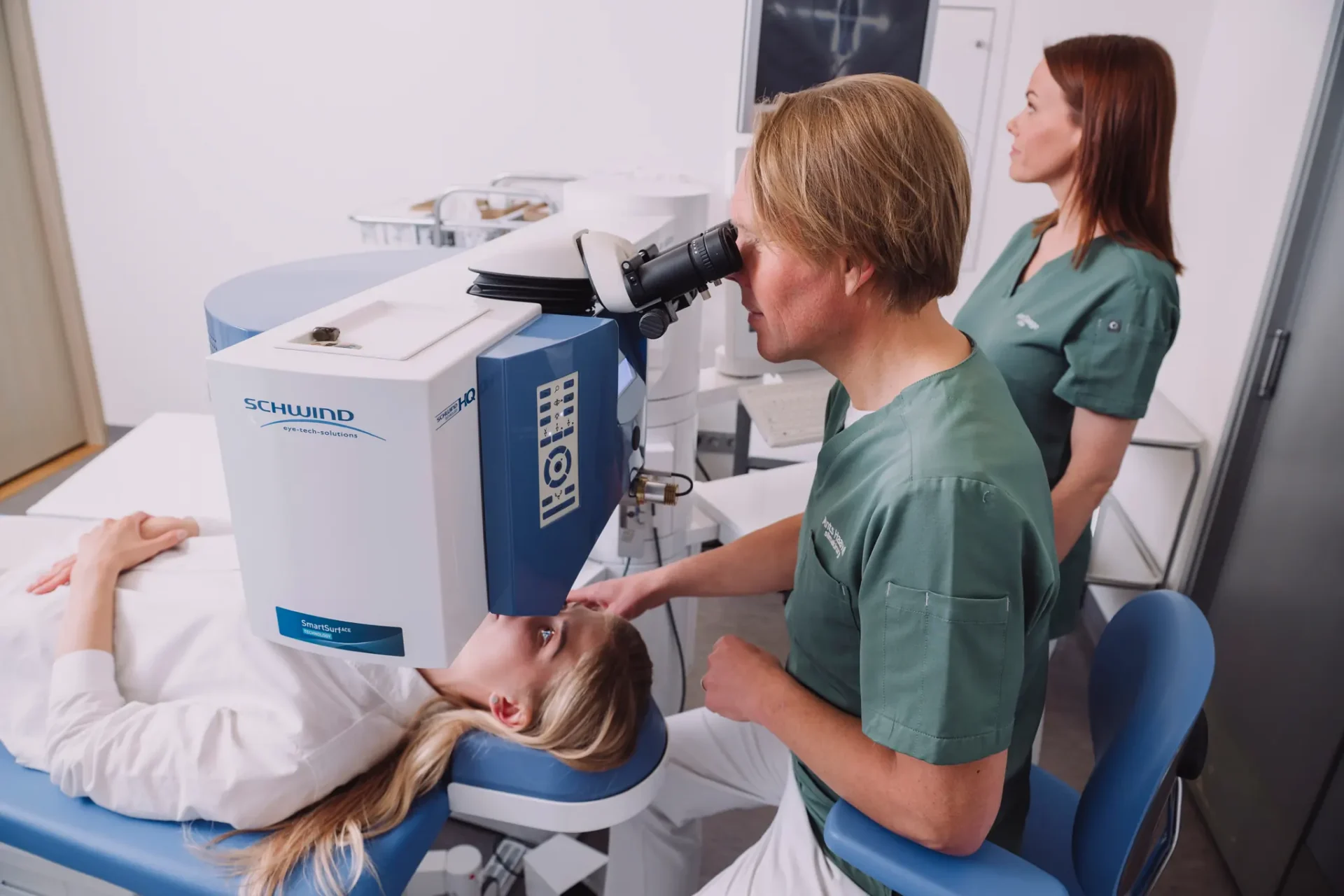
Macula monitoring
A one-year programme for watching the macula: for people at risk of age-related macular degeneration (AMD) or with early changes. Two visits a year, a monthly home test and a written ophthalmologist's assessment after every visit.
279 € a year · 2 visits · Tallinn and Tartu
Who the programme is for
- Early dry AMD: drusen or pigment changes that do not yet affect vision but need watching.
- AMD in a close relative. The risk is inherited, and the first changes show on OCT (optical coherence tomography) years before you can feel them.
- One eye already under treatment or damaged — to watch the other.
- Usually from the age of 55; earlier for smokers and where there is a family risk.
How the year works
The macula is the centre of the retina, the part you read and recognise faces with. Age-related degeneration is usually slow and unnoticed, but the dry form can turn wet. Then every week counts, because treatment works best when it starts early. The point of monitoring is to catch that moment.
The first visit is a full examination with an optometrist, the same scope as the Audit eye examination, plus the macula tests: OCT, OCT angiography and a fundus photograph. The second visit six months later is short: a KSA assistant repeats the measurements, which the ophthalmologist compares with the earlier ones.
Between visits there is your own Amsler test: a grid at home on which bent lines or a blank patch appear before visual acuity drops. You report the result once a month through the support line. If something changes suddenly, nobody waits for the next visit.
Visits during the year
Full baseline examination
optometrist · about 60 min · at the start
- Visual acuity and refraction
- OCT of the macula: retinal layers, drusen, fluid
- OCT angiography: the macular vessels without contrast dye
- Fundus photograph for comparison
- Amsler test and a guide to take home
- Eye pressure, cornea and the front of the eye as in the Audit examination
The ophthalmologist stages the AMD, assesses the risk in each eye and the treatment options, and sets the monitoring plan.
Measurement visit
KSA assistant · about 30 min · after 6 months
- Visual acuity
- OCT of the macula
- Fundus photograph and comparison with the previous one
- Amsler test
Written ophthalmologist's assessment within 7 days: whether the finding is stable and whether anything has been added.
At home, every month
you and the support line · 2 minutes · between visits
- Amsler test, each eye separately
- Result through the support line
If the lines bend or a blank patch appears, call the same day.
What we measure with
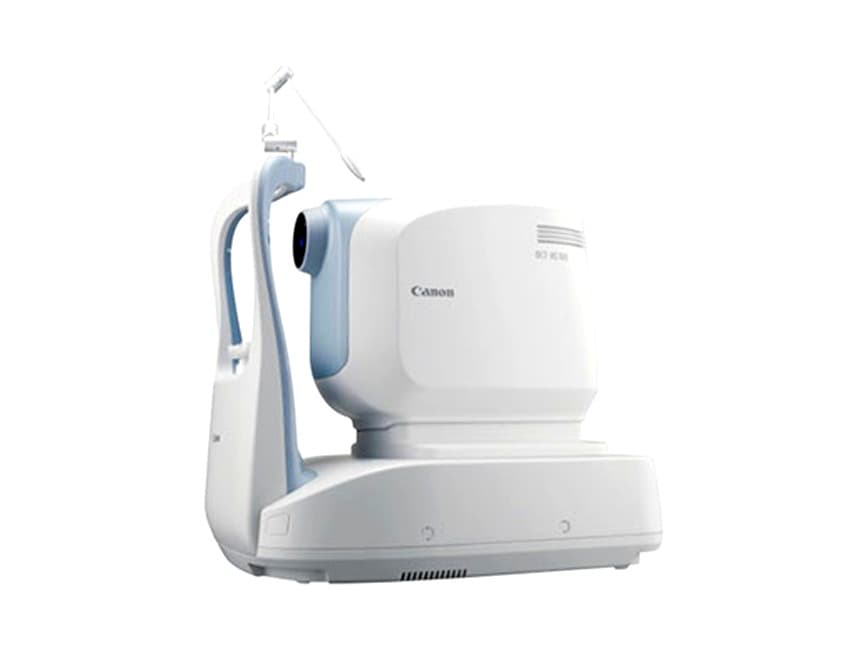
Canon OCT-HS100
3D scanning of the retina and optic nerve at microscopic precision. A change shows before you can feel it.
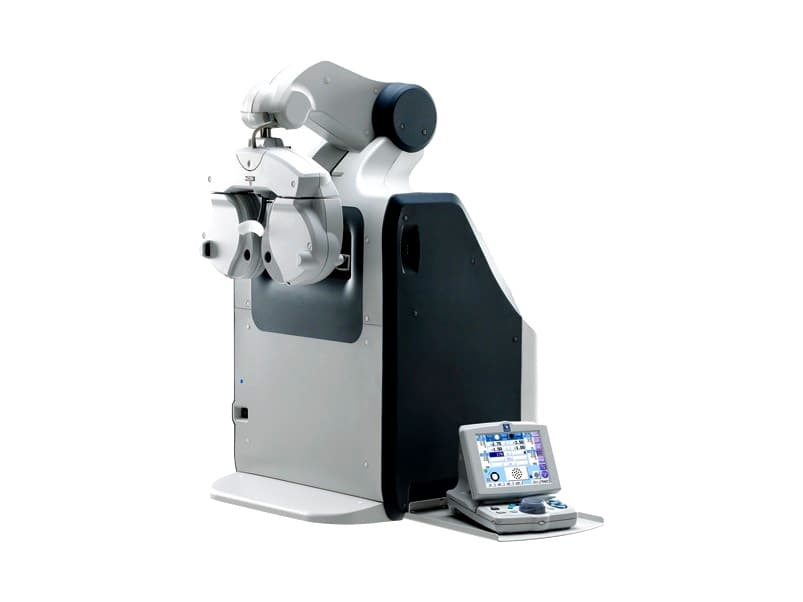
Nidek TS-310
Digital measurement of visual acuity and prescription that gives the same precise result every time.
If anything is still unclear...
An optometrist takes the measurements at the first visit and a KSA assistant at the second, on the same instruments each time so that the images are comparable. The ophthalmologist reviews both visits and gives a written assessment. If a finding needs a doctor's appointment, we arrange one separately.
Do not wait for the next visit. Call the support line the same day. Bent lines or a new blank patch can mean that the dry form has turned wet, and then time matters: treatment works best when it starts early.
A supplement with a specific composition (the AREDS2 study formula) slows the progression of moderate dry AMD. In the early stage and for prevention no effect has been shown. The ophthalmologist says in the assessment whether it makes sense for your eyes.
Then we do not wait for the next visit. The doctor contacts you, explains the finding and agrees the next steps with you quickly.
Part of every programme payment accrues to your KSA account as credit. It can be used for treatment and treatment products at KSA. The credit is valid for five years from the last payment and is not transferable.
Yes. Every visit includes an ophthalmologist's assessment, so it is a healthcare service.
Keep the macula in view
Book the first visit. It is the full examination that the comparison starts from.