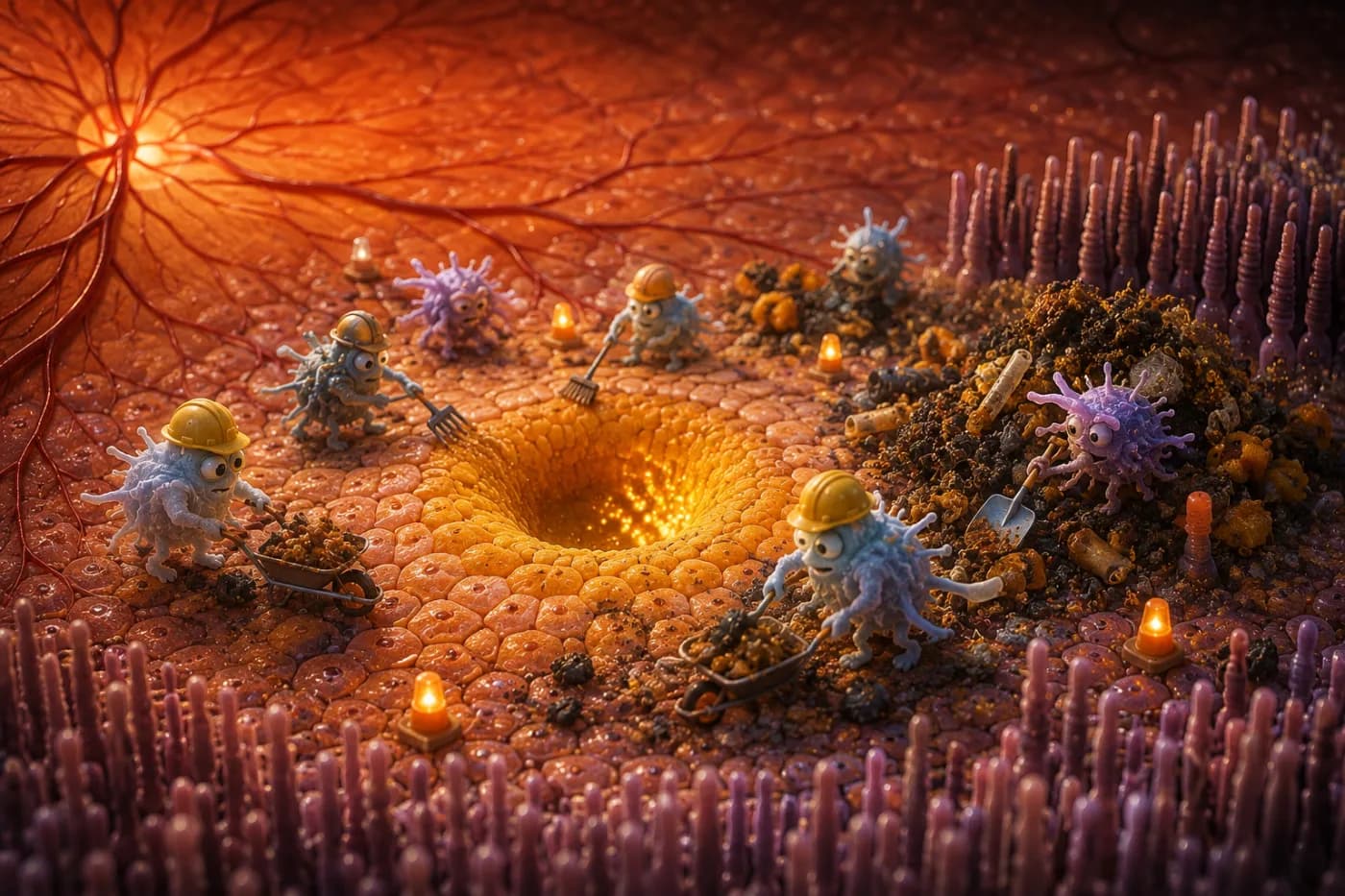
We live in an era of relentless digital stimulation. We wake up and immediately check our phones, spend the entire day staring at office monitors, and unwind at night with television or tablets. While we often worry that screens cause temporary eye strain or mental fatigue, the biological truth is far more severe: our digital lifestyle is quietly building a massive toxic clog in the cellular waste-clearance pathways of both our eyes and our brain.
Vision and cognitive function are not isolated processes; they represent a 50/50 biological partnership between our eyes and our brain. For this intricate network to process information at high speeds and high resolutions, a specialized team of microscopic "garbage collectors" and "gardeners" must operate uninterrupted.
However, late-night screen exposure, constant blue light, and round-the-clock snacking act as a biological cork, halting the natural cleaning shifts of these essential tissues.
Recent scientific discoveries reveal how our modern digital habits disrupt these cleanup systems at a molecular level, and outline the exact steps we can take to keep our visual and neural pathways completely clear.
Chronobiological Housekeeping: The Specialized Cell Shifts
The clearing systems of the body operate on strict circadian rhythms governed by our master biological clock. The cells responsible for keeping our eyes and brain clear of debris have distinct, non-negotiable working shifts:
The Eye's Morning Shift (RPE). The light-sensing photoreceptors (rods and cones) in the retina undergo extreme metabolic stress throughout the day. Every morning, as light first enters the eye, they shed their damaged, oxidized outer tips. The Retinal Pigment Epithelium (RPE) cells, lying directly beneath them, act as highly active garbage trucks—immediately engulfing, digesting, and recycling these discarded outer segments. This morning routine is vital to prevent metabolic waste from clouding our visual field.
The Brain's Night Shift (Microglia). While the eye cleans in the morning, the brain's visual cortex conducts its major cleaning cycle during deep sleep. As we learn and experience the world during the day, we build countless neural connections (synapses). During deep sleep, the brain initiates the synaptic homeostasis hypothesis: it systematically weakens the least-used, non-essential connections. Specialized immune cells called microglia then perform "synaptic pruning"—acting like microscopic gardeners to trim away the weak connections, shrinking overall synaptic density by about 20% to free up cognitive space for the next day.
When this clock is disrupted, biological waste begins to accumulate in both tissues.
Blue Light and Melatonin Suppression: Halting the Brain's Night Shift
The most damaging blow to the brain's nightly cleaning crew is delivered by late-night screen use. Digital screens emit short-wavelength, high-energy blue light, which our biological clock interprets as bright, midday sun.
This artificial light severely suppresses the secretion of melatonin, the hormone responsible for signaling the body to sleep. Melatonin is not just a sleep-inducer; it is the master switch that opens the window to deep, slow-wave sleep.
When melatonin is suppressed:
- Deep Sleep is Curtailed: The body is deprived of the deep, restorative sleep phases required for neural regeneration.
- Microglia Stand Down: Because microglial synaptic pruning and the flushing of metabolic toxins (including harmful proteins like beta-amyloid) occur predominantly during deep sleep, the cleaning shift is cut short.
- A Cluttered Neural Network: We wake up with un-pruned synapses, trapped metabolic waste, and a persistent feeling of brain fog. Over time, this chronic lack of clearance accelerates cognitive decline and memory impairment.
Digital Eye Strain: The Destruction of Meibomian Glands and Cellular Fatigue
The impact of screens goes far beyond sleep disruption; it inflicts direct, irreversible physical damage on the ocular surface. Observations at KSA Vision Clinic and global clinical trials show that screen use reduces the human blink rate by up to 75%.
This severe reduction in blinking triggers a destructive cascade:
Meibomian Gland Atrophy. Healthy blinking is required to compress the meibomian glands along the eyelid margins, releasing a crucial lipid layer that prevents tears from evaporating. When blinking is incomplete and rare, these glands become clogged and begin to permanently wither away (atrophying). This structural decay, once observed only in elderly patients, is now frequently diagnosed in young children and screen-heavy young adults. The resulting evaporative dry eye syndrome cannot be cured by artificial tears, as the protective oil barrier is permanently lost.
Deep Cellular Exhaustion. The constant stress of blue light and lack of darkness keeps the lysosomal (recycling) pathways of RPE cells and photoreceptors overworked. They are deprived of the restorative dark phases needed to regenerate vital enzymes, particularly PIKfyve. When PIKfyve activity is compromised, the photoreceptors' internal recycling engines fail, leading to rapid cellular stress, waste accumulation, and premature cell death.
Autophagy Interrupted: Constant Stimulation and Late-Night Snacking
Our cells have a built-in recycling mechanism called autophagy (literally "self-eating"). This process allows cells to package up damaged proteins, oxidized lipids, and worn-out machinery, delivering them to lysosomes for destruction and recycling. However, autophagy is highly sensitive to energy levels; it is only activated when cells are in a fasted, resting state.
The modern habit of late-night screen watching is often paired with constant snacking. This continuous influx of carbohydrates and calories keeps insulin levels elevated, signaling to cells that they must remain in growth and consumption mode rather than cleaning mode.
This continuous stimulation results in:
- The complete shutdown of cellular autophagy.
- The inability of RPE and photoreceptor lysosomes to perform routine "inventory" and clear accumulated lipid droplets and cellular debris.
- The compression of this undigested waste into toxic, yellowish deposits called drusen under the retina, driving the development of dry Age-Related Macular Degeneration (AMD).
How to Prevent the Digital Clog: Actionable Protection Steps
We do not have to abandon modern technology, but we must provide our cells with the necessary biological windows to execute their cleaning tasks. Here are the scientifically backed steps to protect your eyes and brain:
1. Implement a Strict Digital Curfew
Turn off all digital screens at least 1–2 hours before bedtime. This allows your brain to produce melatonin naturally, securing the deep sleep phases your microglia require to execute their nightly pruning and toxin-flushing shift. If evening screen use is unavoidable, use heavy blue-light filters or dedicated glasses, but remember that these are minor shields, not a replacement for true screen-free rest.
2. Practice the 20-20-20 Rule and Conscious Blinking
Every 20 minutes of screen time, look at an object at least 20 feet away for at least 20 seconds. This simple action relaxes your ocular muscles and serves as a trigger to perform several deep, complete blinks, keeping your meibomian glands active and protecting them from permanent atrophy.
3. Commit to Regular Aerobic Exercise
Physical movement is direct medicine for your retinas and your brain. Landmark studies prove that regular aerobic exercise (such as regular, enjoyable jogging or brisk walking) actively suppresses chronic retinal inflammation at the gene level. It downregulates microglial inflammatory genes and suppresses harmful complement cascade activation, shifting your retina's transcriptomic profile back to a healthy, youthful baseline.
4. Incorporate Dietary Pauses for Autophagy
Adopt a structured eating window (such as 16 hours of fasting and 8 hours of eating) and strictly avoid late-night snacks. This dietary boundary gives your photoreceptors' PIKfyve pathways and RPE lysosomes the metabolic window they need to initiate autophagy, clearing out accumulated lipids before they can aggregate into toxic, vision-clouding drusen.
At KSA Vision Clinic, we understand that healthy vision is not just a matter of lens prescription; it is a reflection of how well your eyes and brain coordinate their daily biological housekeeping. By protecting your sleep, prioritizing movement, and establishing metabolic boundaries, you directly support the microscopic cleaning crews in your head—ensuring sharp, crystal-clear vision for a lifetime.