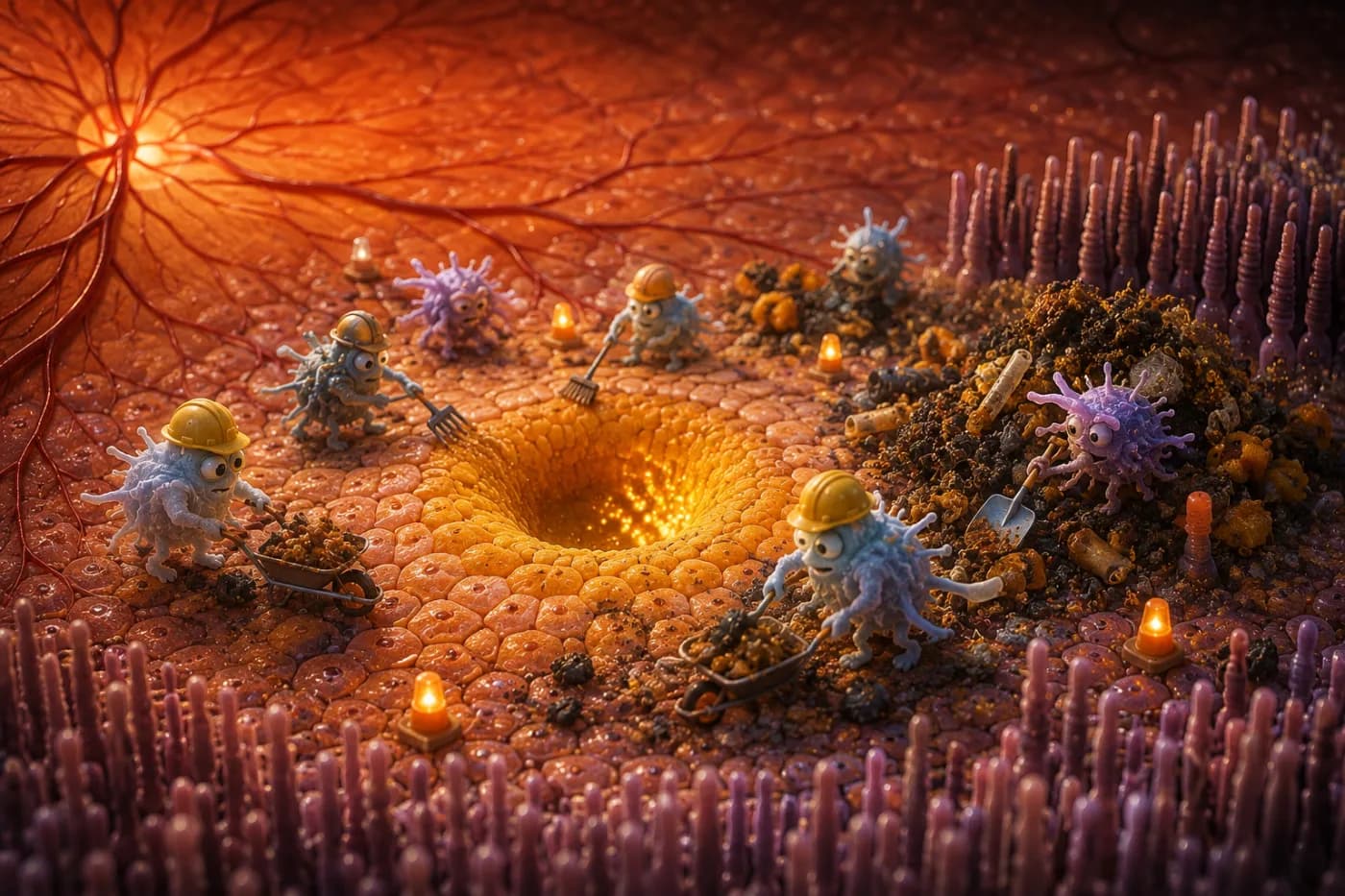
When we look at a beautiful landscape or read a line of text, we perceive our eyes as stable, permanent instruments, much like the high-quality glass lenses in a camera. However, biology operates on a completely different principle. Our eyes are not static lenses; they are dynamic, living systems that undergo constant self-reconstruction to preserve our sight.
Every single day, your eyes quietly shed and rebuild about ten percent of their primary light-sensing structure. By this time next week, the microscopic machinery you are using to read these words will have been completely recycled and replaced with brand-new biological parts.
This continuous renewal is one of the most notable maintenance operations in the human body, acting as a vital defense against the intense physical and chemical demands of vision.
The Hostile Environment of the Outer Retina
To understand why our eyes must rebuild themselves so frequently, we have to look at the extreme conditions under which our photoreceptors—the light-detecting rod and cone cells—operate.
Photoreceptors are positioned at the very back of the retina, where they face a double-edged sword of physiological stress. First, they are constantly exposed to high-energy visible light focused by the cornea and lens. Second, they have a high demand for oxygen, containing more than sixty percent of the retina's mitochondria packed into a specialized region called the ellipsoid.
This combination of intense light exposure and rapid oxygen consumption creates a high-stakes environment. As a natural byproduct of their intense energy production, the mitochondria continuously generate reactive oxygen species—unstable molecules that cause oxidative stress. Over time, this stress inevitably damages the delicate lipids and proteins that form the membrane discs inside the photoreceptors' outer segments, where light is captured.
If these damaged proteins and lipids were allowed to accumulate, the photoreceptor cells would quickly lose their functionality and begin to degenerate, leading to permanent vision loss.
The RPE: The Retina's Microscopic Recycling Plant
To prevent this decay, the visual system relies on a highly coordinated partnership between the photoreceptors and a single layer of cells sitting directly behind them: the Retinal Pigment Epithelium, or RPE.
Every morning, in response to the first light of day, the tips of the photoreceptors' outer segments shed their oldest, most damaged membrane discs—about ten percent of their total length.
As these damaged segments are cast off, the RPE cells immediately step in. Through a process called phagocytosis, the RPE engulfs the shed discs and digests them. Rather than discarding these materials, the RPE operates as a highly efficient recycling plant:
- Recycling Key Nutrients: The RPE breaks down the digested segments and extracts valuable components, such as visual pigments and essential lipids.
- Rebuilding the Base: These recycled elements, along with fresh nutrients from the bloodstream, are transported back to the photoreceptors.
- Continuous Growth: Using these returned building blocks, the photoreceptors continuously manufacture new membrane discs at their base, gradually pushing the older discs upward in a conveyor-belt fashion.
Through this elegant cooperative loop, the entire light-sensitive segment of your photoreceptors is completely renewed roughly every ten days.
A Symphony of Maintenance and Protection
The RPE is not alone in maintaining this delicate ecosystem. Other specialized cells, such as Müller glia, work in harmony to support the retina's health. Müller glia act as structural and metabolic anchors, providing vital nutrients to the photoreceptors and recycling neurotransmitters like glutamate to maintain the fidelity of signal transmission and prevent neurotoxicity.
Additionally, the retina employs homeostatic molecular pathways, such as the mTOR pathway, which senses nutrient availability and regulates cellular metabolism, ensuring that energy consumption is balanced with the resources available. When cells experience endoplasmic reticulum stress from synthesizing the massive volume of proteins required for outer segment renewal, a mechanism called the unfolded protein response temporarily reduces protein synthesis to clear out any misfolded proteins, ensuring that only perfectly functioning parts are built.
Protecting the Machinery for a Lifetime
This constant cycle of shedding, digesting, and rebuilding is what allows our visual system to remain resilient over a lifetime of exposure to light. However, because this system operates at such an intense metabolic baseline, it is highly sensitive to aging and metabolic disruptions.
When the RPE becomes overwhelmed or lacks the energy to perform its daily recycling duties, cellular waste can begin to accumulate behind the retina, slowly starving the photoreceptors of oxygen and nutrients. This decline in mitochondrial health and waste clearance is a key driver in progressive age-related conditions like macular degeneration.
Understanding that our vision relies on a continuous, active process of self-reconstruction reminds us that healthy sight is not a passive state. It is a dynamic performance supported by a quiet, dedicated cellular network that works behind the scenes to rebuild our visual world every single day.