Every single time you read a message on your smartphone or glance across the street, your eyes perform an extraordinary engineering feat. They do not glide smoothly like a camera on a motorized slider. Instead, they make several lightning-fast ballistic jumps and brief pauses every second. In medical science, these rapid jumps are called saccades.
Throughout a typical day, each of us executes more than 100,000 saccades. And here lies the fascinating breakthrough: controlling where your eyes land is one of the most computationally demanding tasks your brain performs. When delicate neural circuits begin to experience stress, fatigue, or neurodegeneration, the dynamics of how your eyes move change long before you notice any memory issues.
Could a 5-minute non-invasive gaze test soon answer the question: "How is my brain really performing?"
Why Moving Your Eyes Is a Stress Test for Neural Circuits
It is easy to imagine that eye movements are controlled merely by the six tiny muscles attached to each eyeball. But those muscles are simply mechanical actuators. The real conductor sits deep within the brain.
To direct your gaze from the beginning of this sentence to the next word, multiple brain regions must synchronize within milliseconds:
- The visual cortex perceives and processes visual stimuli
- The frontal eye fields make executive decisions about where to direct visual attention
- The basal ganglia initiate and gate motor commands
- The cerebellum fine-tunes velocity, trajectory, and landing precision
If microscopic neural pathways begin to degrade—whether due to early Alzheimer's pathology, Parkinsonian changes, or cognitive strain—the orchestra loses its rhythm. The eyes begin to struggle with rapid, precise transitions.
What Scientists Discovered with a Simple Reading Test
In recent clinical research, participants performed a standardized computerized reading task (the King-Devick test), reading numbers rapidly from left to right while high-precision eye-tracking systems recorded their gaze kinematics.
The findings uncovered distinct digital biomarkers of early impairment:
Shortened Saccade Duration. Individuals in the earliest stage of cognitive decline (a Clinical Dementia Rating–Sum of Boxes / CDR-SOB score of 0.5—a stage so subtle that friends and family rarely notice any memory problems) exhibited a significantly shorter mean saccade duration compared to healthy controls.
Reduced Saccade Amplitude. As cognitive impairment progressed, the amplitude of saccades—the physical span covered by each rapid eye jump—became significantly restricted. Rather than sweeping confidently across the page, the gaze became hesitant, breaking into smaller, segmented jumps.
The brain was working harder to maintain accuracy, but processing speed and motor coordination were already compromised.
Technological Breakthrough: How NeuroFET Locks Onto the Retina
Traditional eye-tracking cameras monitor the perimeter of the pupil. However, pupils naturally constrict and dilate with changing ambient light, emotional arousal, or fatigue, requiring cumbersome, repeated manual calibration.
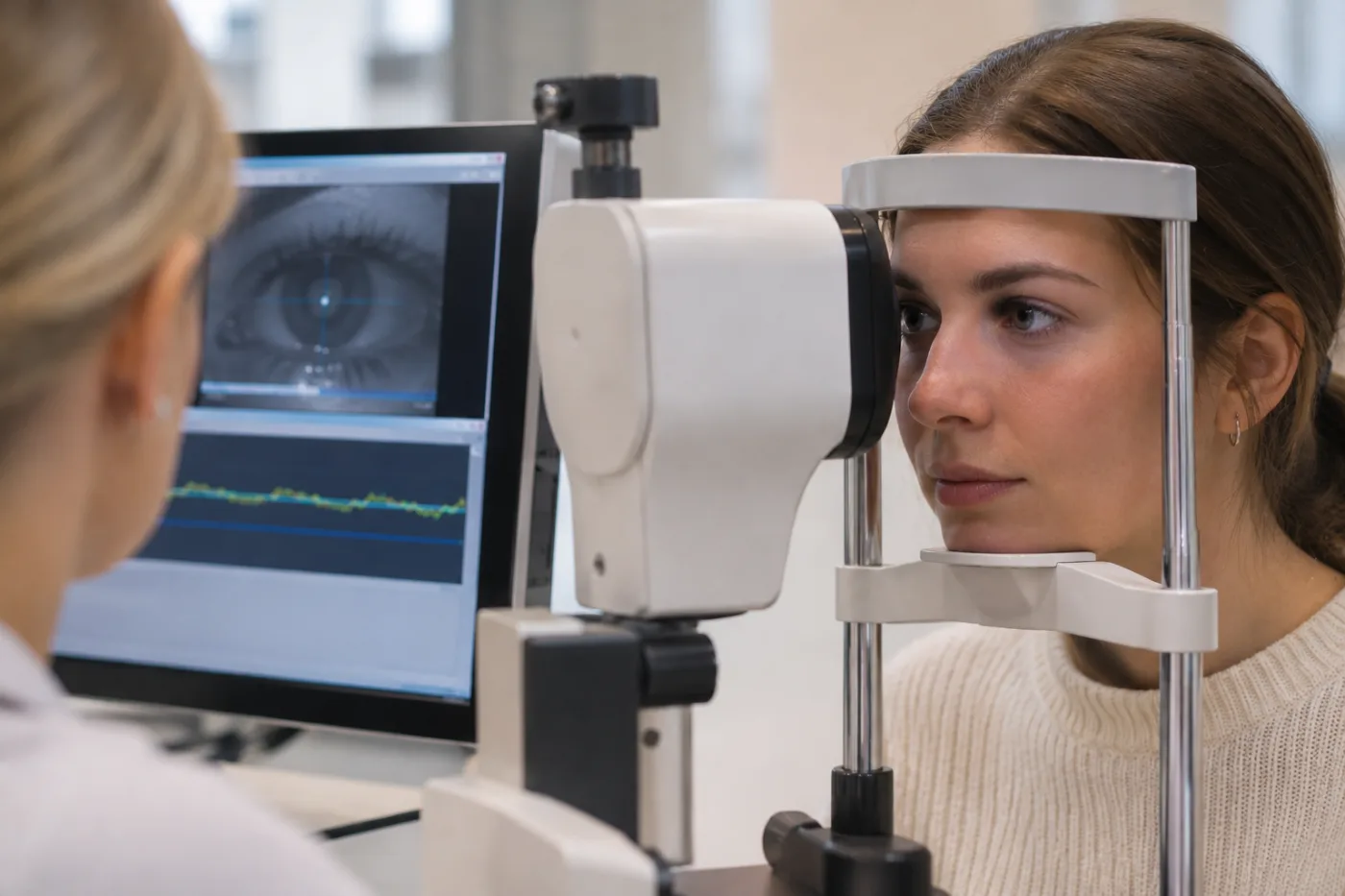
To overcome this, medical innovators created a next-generation diagnostic platform known as NeuroFET (the Vistula system). Instead of tracking the pupil, this technology uses harmless infrared light to lock directly onto the anatomical vascular and neural landscape of the retina.
What sets this innovation apart?
Ultra-High Frequency. Sampling at 610 frames per second (610 Hz), it detects microscopic ocular tremors and saccadic trajectories invisible to standard cameras.
Zero Calibration. Patients simply rest their head against the device—no chasing dots or manual adjustments required.
Speed and Accessibility. The evaluation takes approximately 5 minutes and is completely effortless and painless.
In clinical trials, this pure ocular signal achieved remarkable diagnostic accuracy: 100% sensitivity in moderate neurological impairment and 83.1% sensitivity in mild stages using an age-independent model!
Static Protein Markers vs. Real-Time Brain Performance
In current neurology, diagnostic methods fall into two distinct philosophies:
PET Scans and Blood Biomarkers. These tests detect whether physical proteins (like amyloid-beta plaques or tau tangles) are present in the body. However, they only indicate static pathology, not how the brain is actively functioning. Furthermore, PET scans cost thousands of euros, require radioactive tracers, and have long waiting queues.
Cerebrospinal Fluid Lumbar Punctures. Accurate, but invasive, uncomfortable, and costly.
Retinal Saccade Tracking. This approach evaluates active neurological performance in real time. It measures how swiftly and seamlessly the brain processes incoming information and commands movement.
In the healthcare of tomorrow, these technologies will complement one another, with rapid, low-cost eye tests acting as accessible front-line screeners.
The Eye Clinic: Future Gateway to Brain Longevity
We routinely visit the dentist for preventative cleanings and take our vehicles for scheduled inspections. Yet we rarely have an objective way to check on our brain health until serious symptoms emerge.
Because the eyes are a direct extension of central nervous system tissue, modern eye clinics are naturally positioned to become accessible centers for cognitive wellness and longevity monitoring.
State-of-the-Art Diagnostics at KSA Today
While functional gaze-tracking systems continue their transition through clinical trials, advanced structural eye imaging has already reached an unprecedented level of precision.
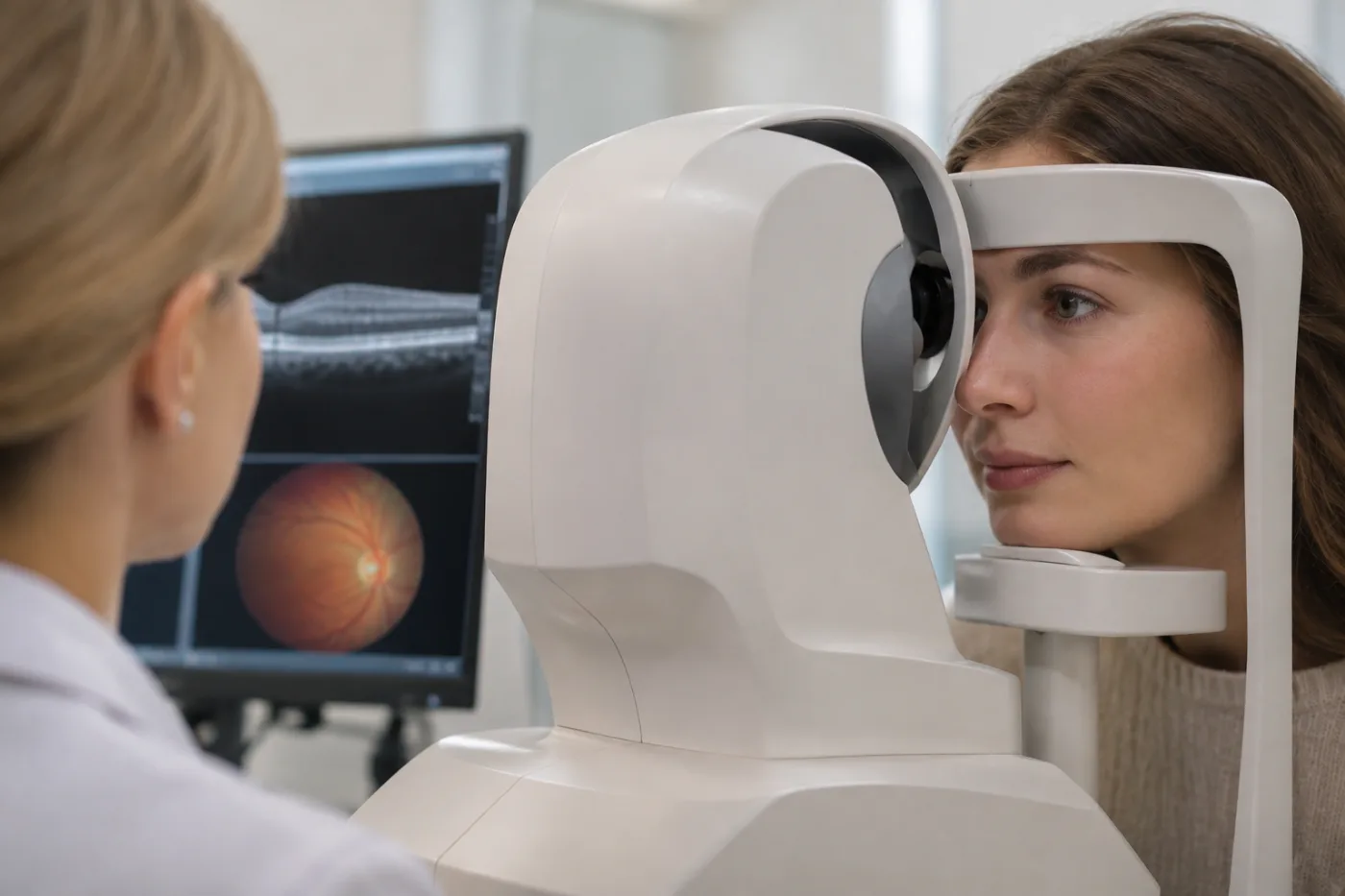
At KSA Eye Center (KSA Silmakeskus), we know that clear vision depends on the health of the delicate neural layers behind the eye. That is why our comprehensive Silmade Audit (Eye Audit) routinely features advanced Optical Coherence Tomography (OCT). Within minutes, this non-invasive scan maps the microscopic nerve fiber and ganglion cell layers of your retina with single-micron accuracy, providing our specialists with vital insights into your ocular and neural anatomy.
The future of healthcare begins with proactive awareness. Keep your vision sharp and your mind bright!